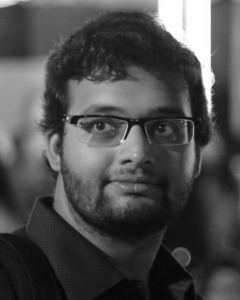
Associate ProfessorThe Alexander Kofkin Faculty of EngineeringBar-Ilan University
About Ran Gelles
I am an Associate Professor at the Alexander Kofkin Faculty of Engineering at Bar-Ilan
University, where I also head the Computer Engineering program. I am interested in distributed computing —
especially in how networks of computers keep working correctly when messages are corrupted, when parts of
the system fail, or when some participants are malicious — and in coding theory and cryptography.
I did my Ph.D. in Computer Science at UCLA, advised by Rafail Ostrovsky and Amit Sahai, and then spent two
years as a postdoc at Princeton University before joining Bar-Ilan in 2016.
News
Service
Head of the Computer Engineering program, Bar-Ilan University2023–present
Ran Gelles is an Associate Professor at the Alexander Kofkin Faculty of Engineering, Bar-Ilan University, where
he heads the Computer Engineering program. His research asks how distributed systems can keep computing
correctly when things go wrong: when messages are corrupted by noise, when parts of the system fail, or when
some participants are malicious.
He joined Bar-Ilan in 2016, after two years as a postdoctoral research associate at Princeton University. He
received his Ph.D. in Computer Science from UCLA in 2014, advised by Rafail Ostrovsky and Amit Sahai, and his
B.Sc. (summa cum laude) and M.Sc. from the Technion – Israel Institute of Technology.
He has been a visiting researcher at CWI Amsterdam, AT&T Labs and Princeton University, and spent his
2022–23 sabbatical at Paderborn University and the CISPA Helmholtz Center for Information Security.
Research
Much of today’s computing is done by many computers working together — phones, servers,
sensors — with nobody in charge. My research asks what such a group can still do when things go wrong: when
messages barely get through, when parts break, and when some members cannot be trusted.
Beeping & content-oblivious
Computing with weak communication
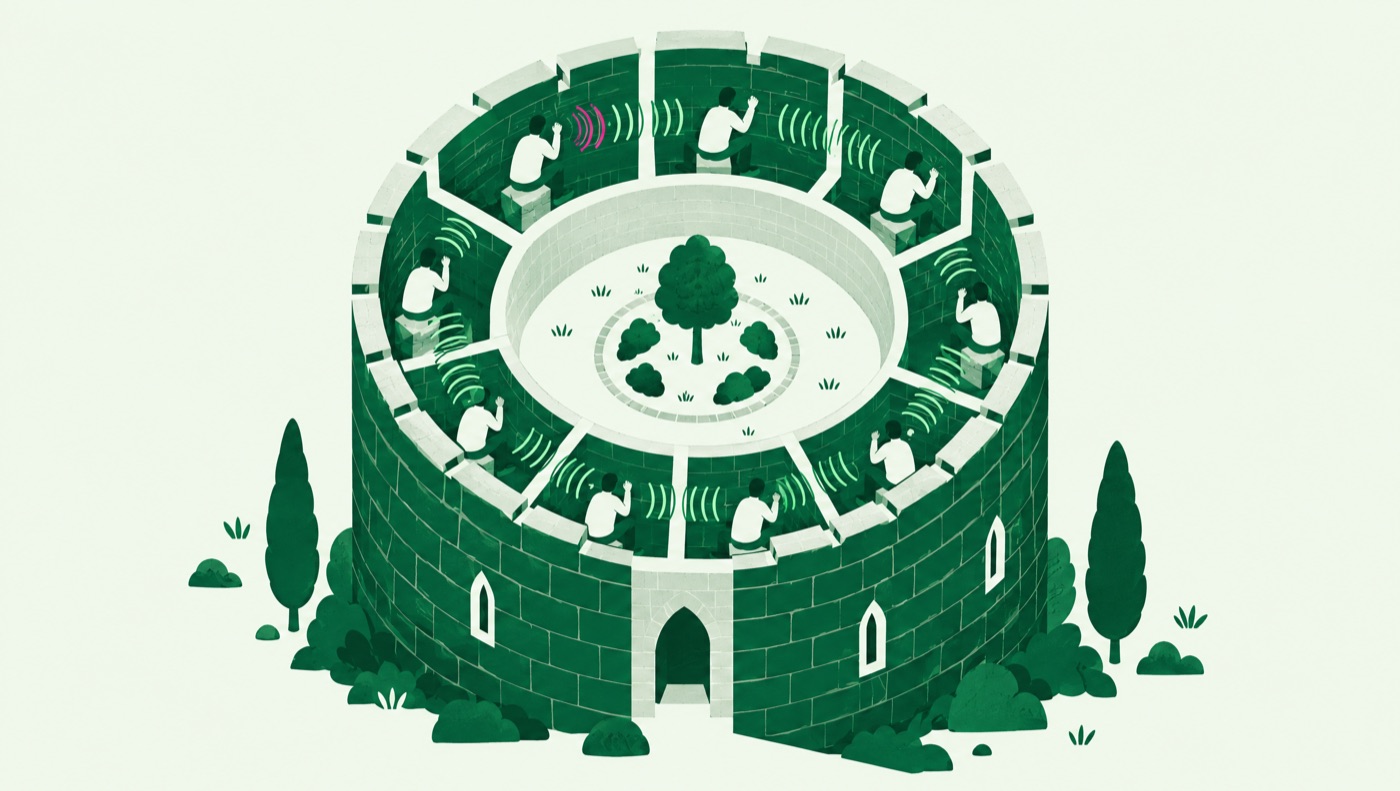
Picture prisoners in neighbouring cells who can only knock on the walls. A knock carries no words — only the
fact that it happened. It sounds hopeless, yet it is enough: as long as any two prisoners are linked by two
separate routes, say with the cells arranged in a ring, knocks alone let them elect a leader and, in
principle, carry out any computation a full conversation could. Tiny sensors that can only emit a pulse,
and living cells that signal with a single chemical, live with the same limits. I study networks like
these, where devices can only beep or every message loses its content on the way, and what they can
still achieve.
Any two nodes in a ring are joined by two separate routes — enough for messages that carry no
content at all.
Recent papers
Fault tolerance
Correct computation when links and devices fail
In the children’s game of telephone, a whispered message is passed down a line and comes out garbled at the
end. Real networks play this game all the time: noise flips bits, adversaries tamper with messages, and
computers crash halfway through a job. In a data centre, where thousands of machines work on one task,
some are always failing. My research shows how a group of computers can keep going
regardless — catching and repairing mistakes in the middle of a long exchange instead of starting over,
working around the parties that have failed, and still finishing the task correctly. Much of it builds on
interactive coding, the theory of protecting entire conversations rather than single messages, which I
surveyed in a monograph.
A garbled message is caught and asked for again; a party that crashed is simply passed
around.
Recent papers
Security despite faults
Secrets that survive noise and traitors
Generals surrounding a city must agree whether to attack, but they can only send messengers — and some of
the generals are traitors, and some messengers never arrive. This old puzzle captures a modern problem:
hospitals that want joint statistics without revealing any patient’s record, or computers that must agree
on a shared history while some of them lie. Cryptography solves such problems assuming the network itself
is perfect. My research drops that assumption, showing that computations can keep their inputs private
and their results correct despite both noise and adversaries, without adding much communication compared
with the original computation.
Four generals, one traitor, and a messenger lost on the way — yet the honest three keep their
secrets and still reach the right decision.
Recent papers
I have also worked on quantum cryptography, data streams, randomized algorithms (e.g., sorting)
and others.
Research supported by the US–Israel Binational Science Foundation (grant 2020277, with V. Zikas
and C. Hazay) and the Israel Science Foundation (grant 1078/17).
Publications
Teaching
Courses I teach at Bar-Ilan. Materials for enrolled students are on the university's Moodle.
Regularly taught
83-453
Distributed Computing
How networks of processors compute without central control: synchronous and asynchronous models, leader
election, consensus and its impossibility, and fault tolerance.
Winter · 2021–22, 2024–2683-867
Probabilistic Methods and AlgorithmsGraduate
Randomness as a tool for algorithms and proofs: the probabilistic method, concentration inequalities, and
the design and analysis of randomized algorithms.
Spring · 2019, 2021, 2024, 202683-870
Advanced Topics in Interactive Coding ProtocolsGraduate
A research-level course on protecting interactive protocols from noise: tree codes, rate and resilience
bounds, and coding over networks.
Spring · 2018, 2020, 2022, 202583-255
Microprocessors and Assembly Language
How a processor runs a program: instruction sets, assembly programming, memory organisation, interrupts,
and input/output.
Spring · 2017–22, 2024–2683-533
Workshop on Software Engineering Project
Student teams take a software system from requirements and design through implementation and delivery.
Spring · 2025–26
Earlier
83-253
Logic Design
Boolean algebra, combinational and sequential circuits, and designing digital systems from gates up.
Winter · 2018–20, 202483-317
Embedded Systems Lab
Hands-on programming of microcontroller-based systems and their peripherals.
Winter · 2021–22
Students
Students and postdocs I have advised. The group has been supported by the Israel Science
Foundation and the US–Israel Binational Science Foundation.
Current
Eviatar Cohen
M.Sc. student, since 2025
Alumni
Eden Fargion
M.Sc., 2020–2025
Eden's M.Sc. research studied interactive coding when there is no bound, fixed in advance, on how
much noise the channel may introduce. It led to Interactive Coding with Unbounded Noise
(APPROX/RANDOM 2024).
Manuj Mukherjee
Postdoctoral researcher, 2020–2021
Manuj worked on multiparty interactive communication over broadcast links (ITW 2021, IEEE JSAIT
2021), ran the group's theory seminar in 2020–21, and has continued collaborating on computation over
noisy networks (ISIT 2024, TCC 2026).
I'm looking for M.Sc. and Ph.D. students interested in distributed computing, coding theory or
cryptography; positions depend on available funding. A strong background in algorithms and probability is
the best preparation. Email me your CV and grade transcripts.
Postdocs
Postdoctoral positions open from time to time, subject to funding. Email me your CV, a one-page research
statement, and the names of two or three referees.